The API Illusion
Building a prototype AI app takes an hour. You send a text prompt to an API, get a response, and display it. It feels like magic.
But when you move to production, the magic shatters. The model hallucinates on proprietary data, times out under load, executes unsafe commands, and fails silently.
Real-world AI isn't a single model—it's a distributed system.
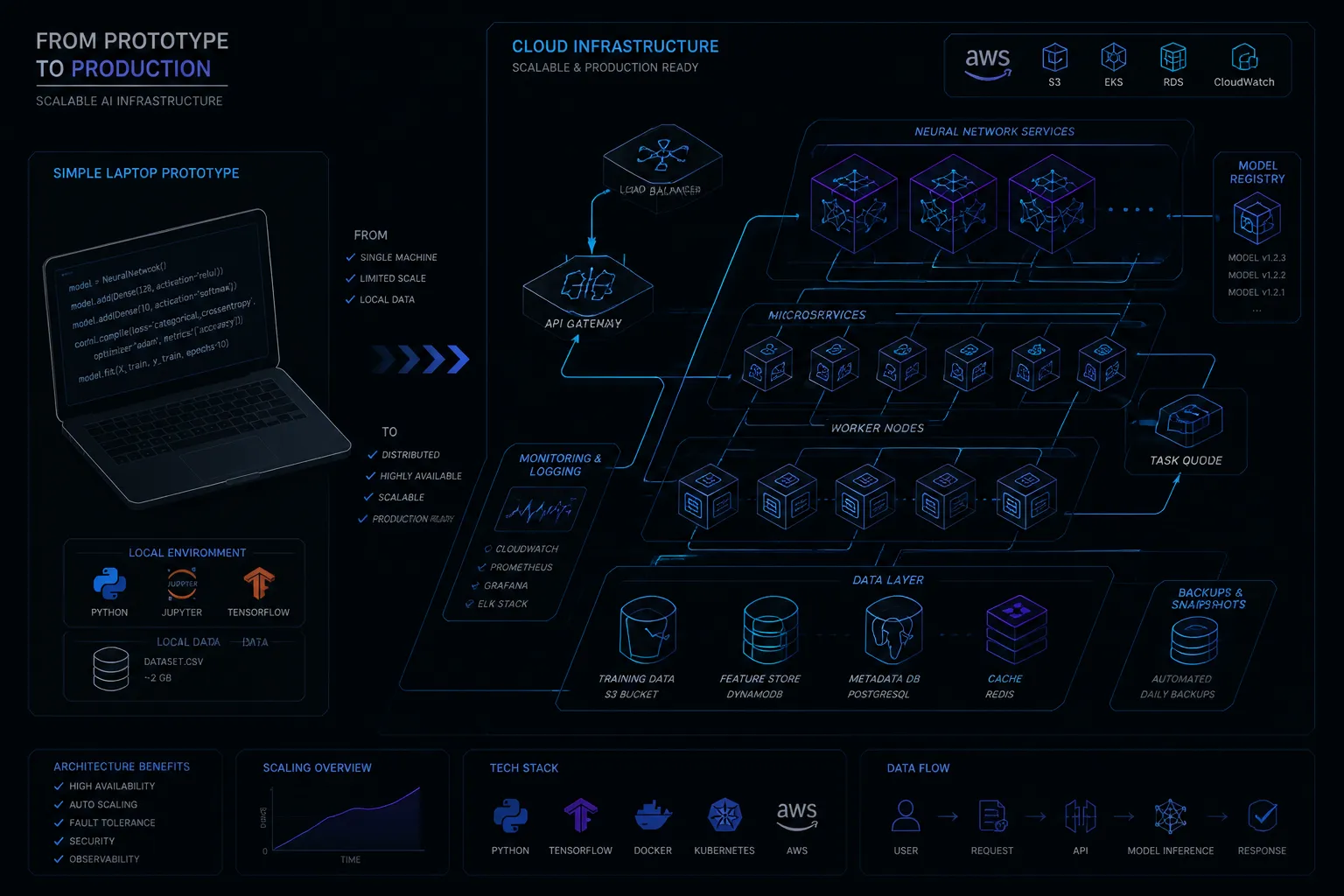
The Production AI Architecture
To build scalable, reliable AI, you must integrate multiple disparate components around the foundation model. The model is just the reasoning engine.
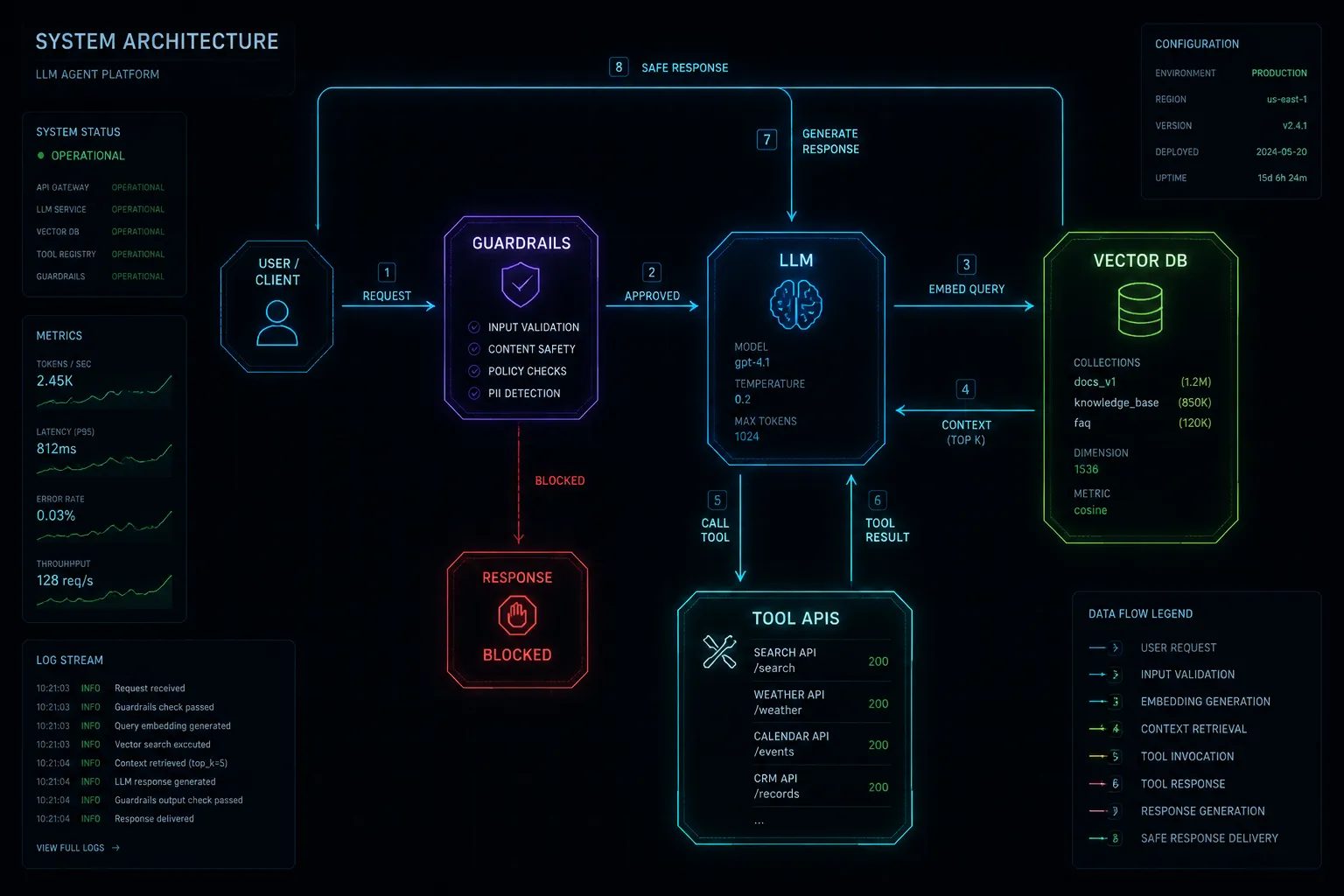
🧠 Foundation Model
The core engine (e.g., GPT-4, Claude). Responsible for language understanding and decision-making, not data storage.
📚 Memory & RAG
Retrieval-Augmented Generation systems inject context. They search vector databases to provide the model with grounded facts.
🛠️ Tools & Agents
APIs and execution environments that allow the model to take action—query databases, send emails, or run code.
🛡️ Guardrails
Validation layers that intercept prompts and responses to block malicious inputs, PII leaks, and dangerous hallucinations.
Knowledge Check
You are designing a customer support bot. It needs to know about a specific user's past purchases before replying. Which architectural component is primarily responsible for injecting this data?
Memory & Retrieval Integration
RAG pipelines transform unstructured enterprise data into searchable knowledge. When a user asks a question, the system:
- Embeds the query into a dense mathematical vector.
- Searches a Vector Database (like Pinecone or Milvus) for similar chunks of text.
- Injects those text chunks into the prompt alongside the user's question.
The Challenge: Semantic search alone isn't enough. Production systems use hybrid search (keyword + vector), re-ranking algorithms, and query rewriting to ensure the retrieved context is actually relevant.
Memory Architectures
Beyond static RAG, conversational systems need Short-term memory (the current chat history, often managed via sliding windows or summarization) and Long-term memory (user profiles and preferences extracted dynamically over time).
Agent Workflows & Tool Ecosystems
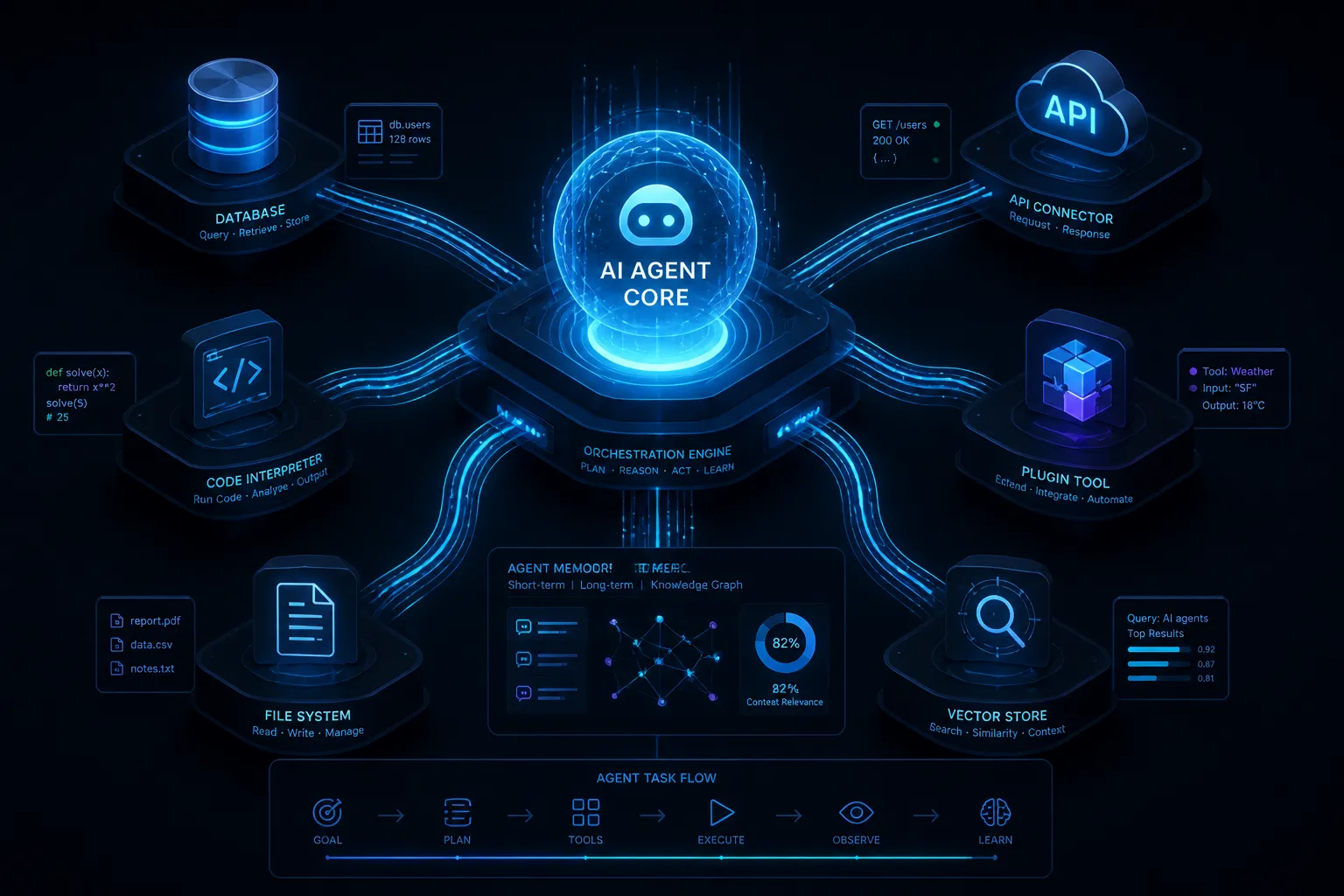
ReAct Prompting
The standard agent loop: Reason about the state, take an Action (call a tool), and Observe the result. It repeats until the goal is met.
Function Calling
Modern LLMs are fine-tuned to output structured JSON matching your API schemas, making tool execution reliable instead of parsing raw text.
Model Context Protocol (MCP)
An emerging open standard that creates universal, secure connections between AI models and external data sources or local tools, standardizing integration.
Knowledge Check
You need your AI to execute a Python script to calculate a financial projection and then summarize the output. Which approach is required?
Workflow Orchestration
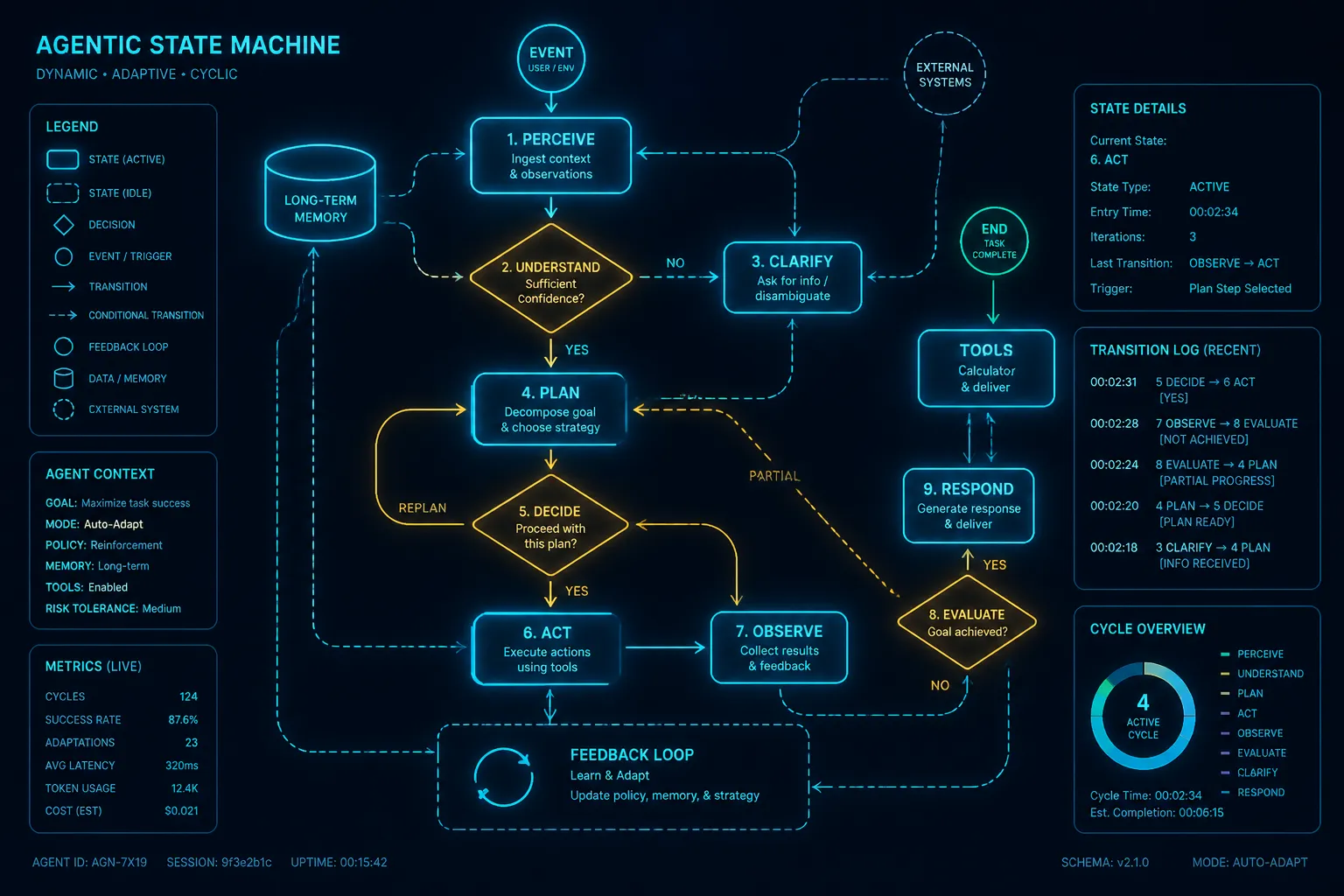
Frameworks like LangGraph allow developers to model AI workflows as graphs with cyclic execution (loops) and persistent state.
Instead of one monolithic agent, production apps often use Multi-Agent Routing: A lightweight router model classifies the user intent and passes the context to a specialized sub-agent (e.g., a "Coding Agent" or a "Support Agent").
This isolates complexity, makes testing easier, and allows different agents to use different, cheaper models where appropriate.
Evaluation & Observability
AI outputs are non-deterministic. Traditional unit tests (expect A to equal B) fail. How do you monitor what you can't strictly predict?
LLM-as-a-Judge
Using a stronger model (like GPT-4) to evaluate the outputs of your system based on rubrics like relevance, toxicity, or faithfulness to retrieved context.
Trace Logging
Recording the entire execution graph (Prompt -> Tool Call -> Result -> Generation). Without traces, debugging a hallucination deep within an agent loop is impossible.
Guardrails in Prod
Running lightweight, fast classifier models in front of the main LLM to block prompt injections, and behind it to ensure formatting and policy compliance before the user sees it.
Key Takeaways
- It's a System: A production AI application requires models, RAG, agents, and observability pipelines working in concert.
- Memory (RAG): Grounding models with vector search solves knowledge cutoffs and reduces hallucination.
- Action (Agents): Function calling and frameworks like MCP allow models to safely interact with external systems.
- Orchestration: Multi-agent routing and state machines provide the control flow necessary for complex tasks.
- Observability: Trace logging and LLM-as-a-judge are mandatory for debugging non-deterministic systems.
Assessment Overview
📝 5 Questions
Test your knowledge on AI system architecture, agents, RAG, and observability. You will need an 80% to pass and earn your certificate.
Note: Once you make a selection, you can move to the next question. Your score will be calculated at the end.
Question 1
In an end-to-end AI system, what is the primary purpose of a Guardrail layer?
Question 2
What is the main difference between a standard RAG pipeline and an Agentic workflow?
Question 3
Why is prompt tracing and observability critical in production AI systems?
Question 4
The Model Context Protocol (MCP) aims to solve which architectural challenge?
Question 5
Which caching strategy is most effective for reducing latency and costs in AI systems serving highly repetitive user queries?